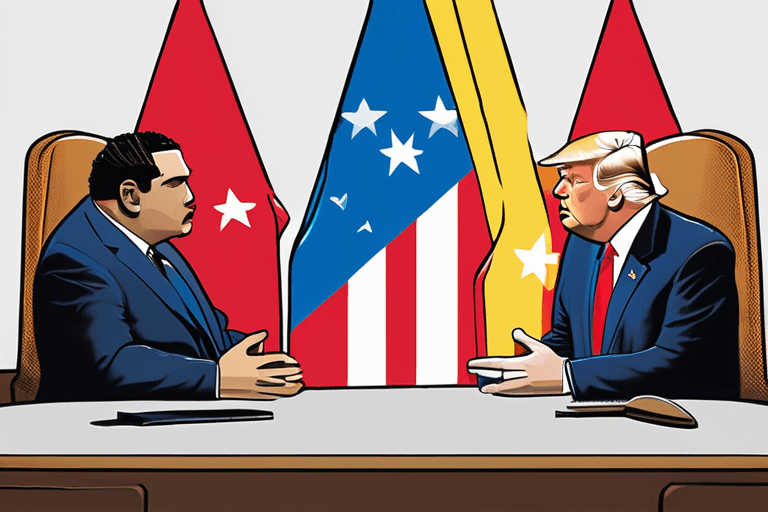
President Donald Trump this week appeared to favor sanctioned Venezuelan Vice President Delcy Rodríguez over opposition leader María Corina Machado, despite Machado's widespread support and Nobel Peace Prize recognition. Trump met with both Rodríguez and Machado in Washington, D.C., offering contrasting assessments of their leadership potential.
Trump described his conversation with Rodríguez, who faces U.S. sanctions for undermining democracy in Venezuela, as "great," stating on Wednesday that they were "getting along very well." He referred to her as a "terrific person" and indicated his support for her potential role in Venezuela's future.
The following day, Trump met with Machado, leader of the Venezuelan opposition and recipient of a Nobel Peace Prize medal. However, according to White House Press Secretary Karoline Leavitt, Trump believes that "based on realities on the ground," Machado lacks the necessary "respect and support" to lead Venezuela. This sentiment echoed previous statements made by Trump, despite evidence of Machado's popularity within Venezuela.
The apparent preference for Rodríguez, a key figure in the Nicolás Maduro regime, raises questions about the U.S.'s approach to Venezuela, particularly concerning the balance between geopolitical interests and democratic values. The U.S. has long maintained a policy of supporting democratic transitions in the region, but Trump's comments suggest a potential shift in strategy.
The situation in Venezuela remains complex, with Maduro clinging to power despite widespread economic hardship and political instability. The U.S. has imposed sanctions on Maduro and his allies, including Rodríguez, in an effort to pressure the regime to hold free and fair elections. However, these sanctions have also been criticized for exacerbating the humanitarian crisis in the country.
Machado, who left the White House after her meeting with Trump and greeted supporters in Lafayette Park, represents a significant challenge to Maduro's rule. She has consistently called for democratic reforms and has garnered considerable support both within Venezuela and internationally.
The contrasting receptions given to Rodríguez and Machado by Trump highlight the ongoing debate within the U.S. government regarding the best course of action in Venezuela. While some advocate for maintaining pressure on the Maduro regime through sanctions and support for the opposition, others argue for a more pragmatic approach that prioritizes stability and economic interests.
The implications of Trump's stance on Venezuela are significant, potentially impacting the country's political future and the broader regional dynamics. The U.S.'s role in promoting democracy in Latin America is being closely watched, and any perceived shift in policy could have far-reaching consequences. The next steps for the U.S. administration regarding Venezuela remain uncertain, but these recent meetings suggest a potential reevaluation of existing strategies.















Discussion
Join the conversation
Be the first to comment