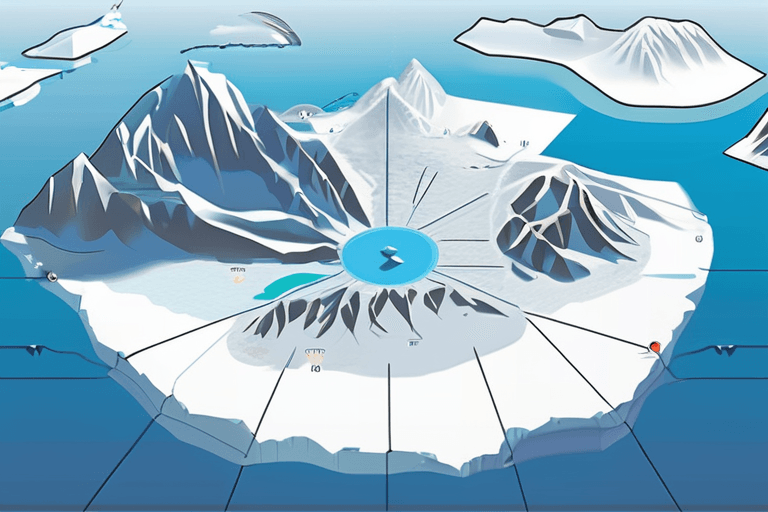
A new map has revealed the landscape beneath Antarctica's icy surface in unprecedented detail, a development scientists believe could significantly improve understanding of the frozen continent. Researchers utilized satellite data and the physics governing the movement of Antarctica's glaciers to deduce the continent's hidden features.
The effort uncovered evidence of thousands of previously unknown hills and ridges, and produced clearer maps of some of Antarctica's concealed mountain ranges than were previously available. Dr. Helen Ockenden, lead author and researcher at the University of Grenoble-Alpes, told BBC News that the improvement in detail is akin to moving "from a grainy pixel film camera, and now you've got a properly zoomed-in digital image of what's really going on."
The creation of the map relied heavily on artificial intelligence, specifically machine learning algorithms, to analyze vast datasets from satellites and ice movement patterns. These algorithms were trained to recognize correlations between surface features and the underlying topography, allowing them to predict the shape of the land beneath the ice with greater accuracy than traditional methods. This process involves feeding the AI system existing data where both the surface and subsurface are known, enabling it to learn the relationships and apply them to areas where the subsurface is hidden.
The implications of this detailed mapping extend to climate change research. The shape of the bedrock beneath the ice influences how glaciers flow and how susceptible they are to melting from warming ocean waters. Understanding the topography allows scientists to create more accurate models of ice sheet behavior and predict future sea-level rise with greater confidence. The newly discovered hills and ridges, for example, could act as either barriers or channels for ice flow, significantly impacting the rate at which ice is discharged into the ocean.
While the maps are subject to inherent uncertainties, the researchers are confident that the new details will shed light on Antarctica's response to climate change. The improved understanding of the subglacial landscape will allow for better projections of ice sheet stability and its contribution to global sea levels. This is crucial for policymakers and coastal communities as they prepare for the potential impacts of rising sea levels.
The project represents a significant advancement in the use of AI in polar science. By leveraging the power of machine learning, researchers are able to overcome the challenges of studying a continent largely hidden from view. Future developments will likely involve incorporating data from other sources, such as radar surveys and seismic measurements, to further refine the maps and reduce uncertainties. The ongoing effort to map Antarctica's hidden landscape is a testament to the power of AI in unlocking the secrets of our planet and informing our response to climate change.













Discussion
Join the conversation
Be the first to comment