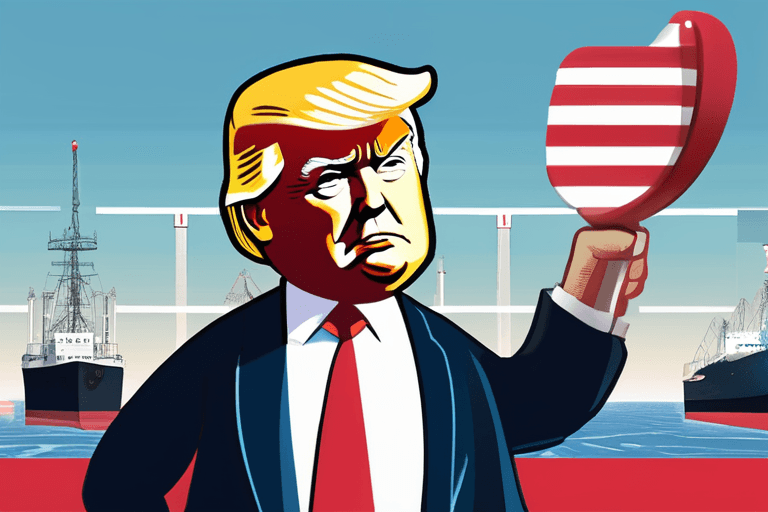
U.S. President Donald Trump threatened Friday to impose tariffs on countries that oppose his ambition to annex Greenland, a self-governing territory under Danish sovereignty. Speaking at a White House meeting, Trump stated he "may put a tariff on countries if they don't go along with Greenland," though he did not specify which nations might be targeted or the legal basis for such tariffs.
Trump's statement came as a bipartisan congressional delegation visited Greenland to demonstrate support for the territory. The 11-member delegation, including Republicans who have expressed reservations about the president's acquisition proposal, met with members of parliament, Danish Prime Minister Mette Frederiksen, and Greenlandic Prime Minister Jens-Frederik Nielsen. Senator Chris Coons, a Democrat and the group's leader, did not comment on the tariff threat.
The notion of the United States acquiring Greenland has a history dating back to the 19th century, reflecting the island's strategic importance due to its location and potential natural resources. In 1946, the U.S. offered Denmark $100 million to purchase Greenland, an offer that was rejected. Greenland is strategically located between Europe and North America and possesses significant mineral resources, including rare earth elements crucial for modern technologies.
Denmark swiftly dismissed Trump's initial expression of interest in purchasing Greenland in 2019, with Prime Minister Frederiksen calling the idea "absurd." The incident strained relations between the U.S. and Denmark, a NATO ally. The current visit by U.S. lawmakers aims to ease tensions and reaffirm the importance of the U.S.-Danish relationship, particularly in the context of Arctic security and cooperation.
The prospect of Greenland's acquisition raises complex questions about sovereignty, self-determination, and the rights of the Inuit population, who constitute the majority of Greenland's inhabitants. Any potential change in Greenland's status would require the consent of both the Danish and Greenlandic governments, as well as consideration of the island's inhabitants' wishes. The situation remains fluid, with the threat of tariffs adding a layer of economic pressure to the diplomatic complexities.

















Discussion
Join the conversation
Be the first to comment