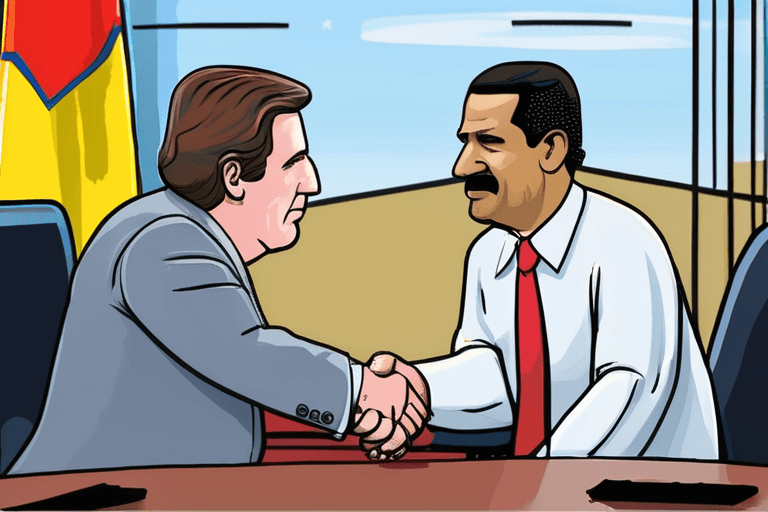
CIA Director John Ratcliffe met with Venezuela's Interim President Delcy Rodríguez in Caracas on Thursday for two hours, according to a U.S. official. The meeting, which occurred at President Trump's direction, aimed to establish trust and communication following the U.S. seizure of former President Nicolás Maduro almost two weeks prior.
Ratcliffe and Rodríguez discussed potential economic collaboration and the need to prevent Venezuela from becoming a safe haven for America's adversaries, the U.S. official stated. The meeting coincided with Rodríguez's first state of the union address as interim president, during which she announced oil industry reforms to encourage greater foreign investment, a departure from Maduro's previous policies.
During her address, Rodríguez stated she was prepared to engage with the U.S. "diplomatically through political dialogue," while emphasizing Venezuela's need to defend its "dignity and honour." President Trump has indicated that U.S. oil companies would move into Venezuela, generating revenue for both the Venezuelan people and the United States, according to a top official.
The meeting highlights the complex geopolitical landscape where artificial intelligence (AI) could play an increasing role. AI-driven tools are already used for analyzing vast datasets to predict political instability, assess economic risks, and even monitor social media for sentiment analysis related to political leaders and policies. This type of intelligence gathering, while not explicitly mentioned in connection with the Ratcliffe-Rodríguez meeting, represents a growing trend in international relations.
The use of AI in diplomacy raises questions about transparency and accountability. AI algorithms, trained on specific datasets, can introduce biases that influence decision-making. For example, an AI system designed to assess the stability of a foreign government might prioritize certain economic indicators over social factors, leading to a skewed assessment.
Recent developments in AI include the use of natural language processing (NLP) to automatically translate and analyze diplomatic communications, potentially speeding up the process of understanding foreign policy objectives. Furthermore, AI-powered simulations can be used to model the potential outcomes of different diplomatic strategies, allowing policymakers to explore various scenarios before committing to a course of action.
The meeting between Ratcliffe and Rodríguez signals a potential shift in U.S.-Venezuelan relations. The extent to which AI will influence future interactions remains to be seen, but its growing presence in intelligence gathering and diplomatic analysis is undeniable. The ongoing dialogue and future developments will likely shape the political and economic trajectory of Venezuela and its relationship with the United States.


















Discussion
Join the conversation
Be the first to comment