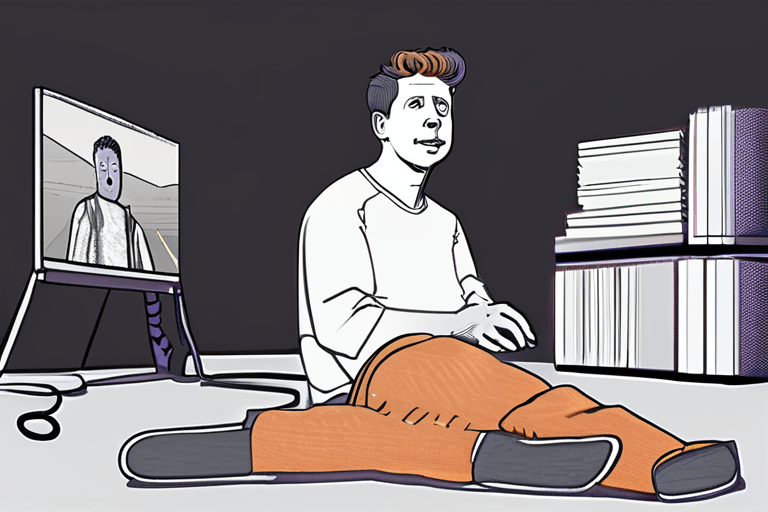
Adam Bhala Lough had a problem. A big, AI-shaped problem. He was making a documentary about the burgeoning world of artificial intelligence, and he needed the oracle himself: OpenAI CEO Sam Altman. Lough envisioned Altman as the next Steve Jobs, a figure destined to reshape the world, for better or worse. "I'm betting that Sam Altman is going to be in that ilk of people who change the world," he told Fortune. But Altman, it seemed, was too busy changing the world to return Lough's calls. So, the director did what any resourceful, Emmy-nominated filmmaker would do: he deepfaked him.
Lough's decision wasn't born in a vacuum. Altman was, and continues to be, a lightning rod. His very public firing and rehiring from OpenAI in 2023, followed by the Scarlett Johansson voice controversy, had cemented his place in the cultural zeitgeist. The Johansson incident, where OpenAI was accused of using a voice eerily similar to the actress for ChatGPT, became the tipping point for Lough. "The Scarlett Johansson thing really just gave me license to do it," Lough explained. "Like he did this to her, so I’m going to do it to him." (OpenAI has stated that the voice was not intended to mimic Johansson.)
The deepfake Altman became more than just a stand-in. He became a character, a digital puppet speaking lines Lough crafted, embodying the anxieties and promises of the AI revolution. But here's where the story takes a turn. Lough, initially driven by frustration and perhaps a touch of mischievousness, found himself developing a strange attachment to his digital creation. He was spending hours crafting Altman's responses, tweaking his expressions, and essentially, building a relationship with a phantom.
This raises a fascinating question about the nature of creation and connection in the age of AI. Are we, as creators, destined to form bonds with our creations, even if they are artificial? The film industry, already grappling with the implications of AI on everything from scriptwriting to visual effects, is watching Lough's experiment with bated breath. Some see it as a cautionary tale, a slippery slope towards a future where reality and fabrication become indistinguishable. Others view it as a bold artistic statement, a commentary on the power and potential dangers of unchecked technological advancement.
"What Lough is doing is pushing the boundaries of documentary filmmaking," says Dr. Emily Carter, a media studies professor at NYU. "He's not just reporting on AI, he's actively engaging with it, forcing us to confront the ethical and emotional complexities of this technology." The audience appeal of Lough's project lies in its inherent meta-narrative. It's not just a film about AI; it's a film about the making of a film about AI, and the increasingly blurred lines between reality and simulation.
Looking ahead, Lough's deepfake Altman raises profound questions about authenticity, consent, and the future of storytelling. As AI becomes more sophisticated, the ability to create convincing simulations will only increase, challenging our perceptions of truth and reality. Whether Lough's film serves as a warning or a catalyst for innovation remains to be seen. But one thing is certain: his strange, evolving relationship with his deepfaked Sam Altman is a sign of the times, a glimpse into a future where the lines between creator and creation are increasingly blurred.



















Discussion
Join the conversation
Be the first to comment