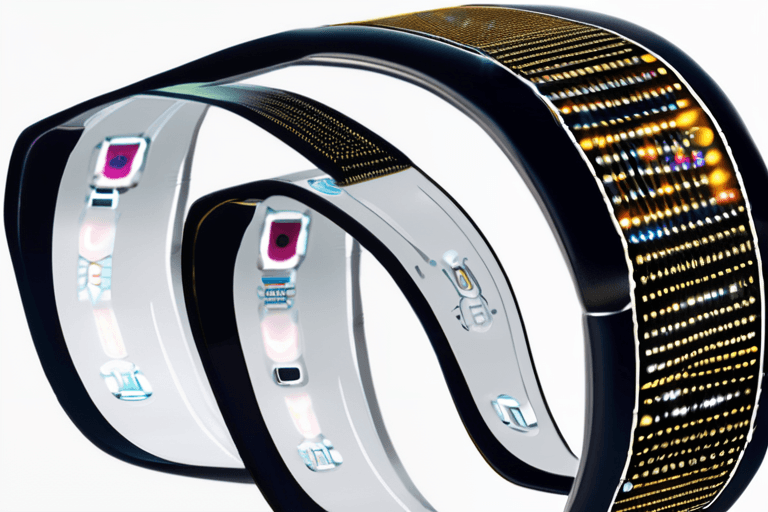
Researchers at Drexel University and Seoul National University announced a breakthrough in stretchable organic light emitting diode (OLED) technology, potentially paving the way for wearable devices and on-skin health sensors, according to a report released January 15, 2026. The new OLED design overcomes a long-standing limitation of flexible displays by maintaining brightness even when stretched dramatically.
The key to the advancement lies in pairing a highly efficient light-emitting material with durable, transparent electrodes made from MXene, a two-dimensional nanomaterial. Tests conducted by the research team demonstrated that the display retained a significant portion of its brightness even after repeated stretching and deformation. This development addresses a critical challenge in the field of flexible electronics, where maintaining performance under strain has been a major hurdle.
OLED technology, already prevalent in flexible smartphones, curved computer monitors, and modern televisions, offers superior image quality and energy efficiency compared to traditional liquid crystal displays (LCDs). However, its application in wearable devices that conform to the human body has been limited by its inability to withstand significant stretching without compromising performance. This new development promises to expand the use of OLEDs into areas such as smart textiles, medical monitoring devices, and interactive skin patches.
The potential applications of stretchable OLEDs extend beyond consumer electronics. Imagine sensors placed directly on the skin, providing real-time information on vital signs such as temperature, blood flow, and pressure. This technology could revolutionize healthcare monitoring, enabling early detection of medical conditions and personalized treatment plans. Furthermore, the ability to create flexible and stretchable displays could lead to innovative human-machine interfaces, allowing for more intuitive and seamless interaction with technology.
While the research team has demonstrated the feasibility of stretchable OLEDs, further development is needed before the technology can be commercialized. Challenges remain in scaling up production, improving the long-term stability of the materials, and integrating the displays with other electronic components. However, the recent breakthrough represents a significant step forward in the quest for truly flexible and wearable electronics, with potential implications for industries worldwide.



















Discussion
Join the conversation
Be the first to comment