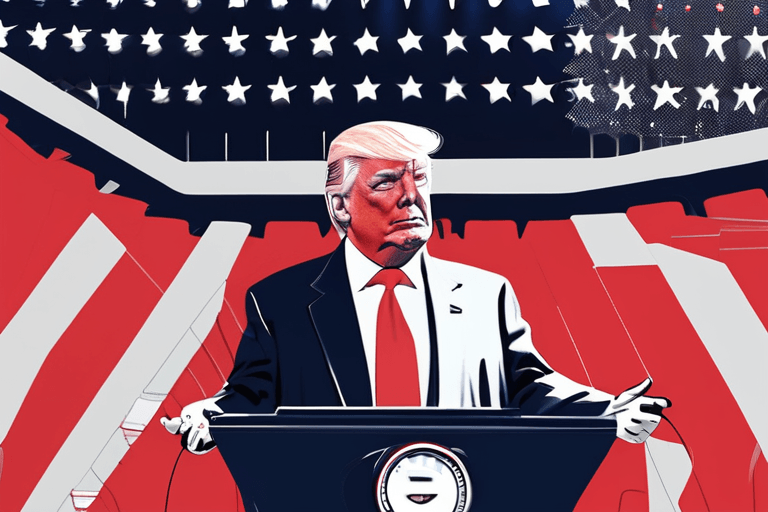
The scene unfolded like a distorted replay of the past. Donald Trump, a year into his second stint in the White House, stood before the press, not quite shouting, but not quite whispering either. He meandered through topics like gas prices and his Queens upbringing, a two-hour performance that left many wondering: Is this a strategic play, or something else entirely?
The question of Trump's mental acuity has long been a subject of speculation, often dismissed as partisan sniping. But recent events, like the rambling press conference and a similarly disjointed primetime address a month prior, have reignited the debate. Are these isolated incidents, or signs of a deeper shift? To understand this, we need to consider the evolving landscape of political communication in the age of AI.
AI is rapidly changing how we perceive and process information. Deepfakes, AI-generated content that convincingly mimics real people, are becoming increasingly sophisticated. While there's no suggestion that AI is directly involved in Trump's recent behavior, the technology highlights a crucial point: our ability to discern reality is under constant assault. We are entering an era where the line between authentic expression and manufactured narrative is increasingly blurred.
"The challenge is not just identifying deepfakes, but also understanding how AI can subtly influence our perceptions," explains Dr. Anya Sharma, a professor of cognitive science at MIT. "Even without malicious intent, AI algorithms can amplify biases and distort our understanding of complex issues."
Trump's communication style has always been unconventional. His rallies are known for their stream-of-consciousness delivery, often punctuated by personal anecdotes and attacks on opponents. But the recent press conference felt different, less calculated, more…unmoored. As Cameron Peters wrote in The Logoff, Trump seemed "more unconstrained and unpopular than ever."
This raises a critical question: How do we evaluate the authenticity of a political leader's message in an age of AI-driven manipulation? Traditional methods of fact-checking and analysis are no longer sufficient. We need to develop new tools and frameworks for assessing the credibility of information and the mental state of those who wield power.
One emerging approach is the use of AI itself to analyze political discourse. Researchers are developing algorithms that can detect subtle changes in language patterns, emotional tone, and cognitive coherence. These tools could potentially identify early warning signs of cognitive decline or manipulation.
"AI can be a powerful tool for detecting inconsistencies and anomalies in speech patterns," says Dr. Ben Carter, a data scientist specializing in political communication. "By analyzing vast amounts of data, we can gain insights into a speaker's mental state that would be impossible to detect through traditional methods."
However, the use of AI in this context also raises ethical concerns. Who decides what constitutes a "normal" speech pattern? How do we prevent these tools from being used to unfairly target political opponents? These are complex questions that require careful consideration.
As Trump prepares to address world leaders in Davos, the stakes are higher than ever. The world order is, as Peters notes, "in shambles." In such a volatile environment, clear and coherent leadership is essential. Whether Trump's recent behavior is a sign of something more profound, or simply a continuation of his unconventional style, it underscores the urgent need for greater vigilance and critical thinking in the age of AI. The future of democracy may depend on it.





















Discussion
Join the conversation
Be the first to comment