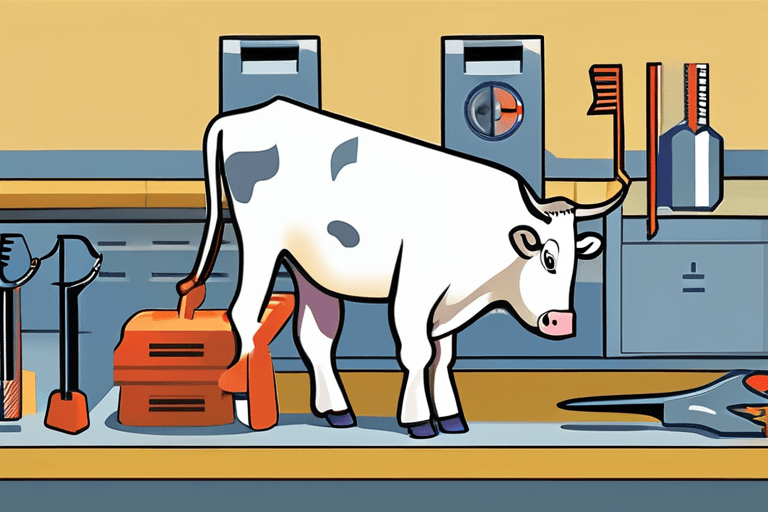
Veronika, a seemingly ordinary pet cow, is rewriting the bovine playbook. Forget placid grazing; this Bos taurus is a tool user, ingeniously employing sticks and brooms to scratch those hard-to-reach itches. This seemingly simple act, documented in a recent Current Biology report, marks the first recorded instance of flexible tool use in cattle, raising profound questions about animal cognition and the very definition of intelligence.
For decades, tool use was considered a hallmark of human intelligence, a defining characteristic separating us from the rest of the animal kingdom. Primates, of course, have long been known to use tools, from chimpanzees fishing for termites with modified twigs to orangutans using leaves as umbrellas. But the discovery of tool use in other species, like crows using hooked wires to retrieve food, and now, a cow scratching herself with a broom, forces us to reconsider our anthropocentric biases.
The observation of Veronika's behavior, meticulously documented by Antonio J. Osuna-Mascaró and Alice M. I. Auersperg, isn't just a quirky anecdote. It's a data point that challenges existing AI models trained to identify and categorize intelligent behavior. Current AI systems, often relying on datasets heavily skewed towards human and primate examples, might fail to recognize Veronika's actions as tool use, highlighting a critical flaw in their design: a lack of diversity in training data. This bias can lead to inaccurate assessments of animal intelligence and potentially hinder our understanding of cognitive evolution.
"What Veronika is doing is significant because it demonstrates cognitive flexibility," explains Dr. Evelyn Hayes, a cognitive ethologist specializing in animal behavior. "It's not just about using an object; it's about understanding the object's properties and applying it to solve a specific problem – in this case, an itch. This requires a level of understanding that we previously didn't attribute to cattle."
The implications extend beyond the scientific realm. As AI becomes increasingly integrated into our lives, from assessing job applicants to making medical diagnoses, the biases embedded within these systems become a societal concern. If AI struggles to recognize intelligence in a cow using a broom, how might it misinterpret or undervalue human intelligence expressed in unconventional ways?
The latest developments in AI are attempting to address these biases. Researchers are exploring techniques like "adversarial training," where AI models are deliberately exposed to diverse and challenging examples to improve their robustness and reduce their reliance on preconceived notions. Another promising approach is "transfer learning," where knowledge gained from one domain (e.g., primate tool use) is transferred to another (e.g., bovine behavior), allowing AI to generalize more effectively.
Veronika's story serves as a powerful reminder that intelligence manifests in unexpected ways and that our understanding of cognition is constantly evolving. As we continue to develop AI systems, we must strive for inclusivity and avoid imposing our own biases onto the natural world. Perhaps, by learning to recognize intelligence in a cow with a broom, we can build AI that is more equitable, insightful, and truly intelligent. The future of AI may depend on our ability to see the world through the eyes of a cow.

















Discussion
Join the conversation
Be the first to comment