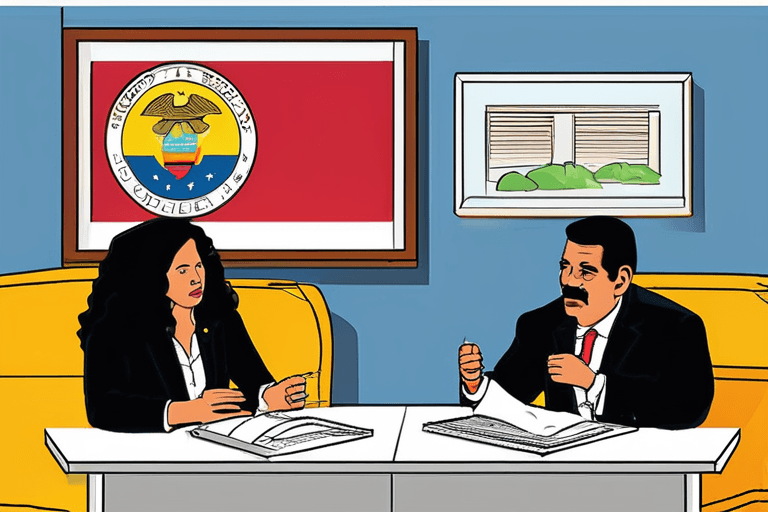
In the tense days leading up to the dramatic capture of Venezuelan President Nicolás Maduro, a clandestine dance of diplomacy was underway. While publicly projecting an image of unwavering loyalty, key figures within Maduro's inner circle, including Delcy Rodríguez, now acting president, were secretly signaling a willingness to cooperate with the United States in a post-Maduro era, according to multiple sources with direct knowledge of the discussions.
Venezuela has been mired in a deep political and economic crisis for years. Maduro's socialist government has faced widespread condemnation for its authoritarian tendencies, human rights abuses, and mismanagement of the economy, leading to hyperinflation, shortages of essential goods, and mass emigration. The United States, under both the Trump and Biden administrations, has pursued a policy of applying pressure on the Maduro regime through sanctions and diplomatic isolation, while recognizing opposition leader Juan Guaidó as the legitimate interim president.
Against this backdrop, the secret communications allegedly initiated by Delcy Rodríguez and her brother Jorge, head of the National Assembly, offer a glimpse into the complex and often contradictory dynamics at play within the Venezuelan government. According to sources who spoke to the Guardian, the Rodríguez siblings, through intermediaries, assured US and Qatari officials that they would welcome Maduro's departure. The motivations behind these alleged overtures remain a subject of speculation. Some analysts suggest it was a pragmatic calculation, a recognition that Maduro's grip on power was weakening and that aligning with the US could offer a path to preserving their own positions. Others believe it may have been driven by genuine concerns about the country's future and a desire to find a way out of the crisis.
"These kinds of backchannel communications are not uncommon in situations like this," explains Dr. Maria Ramirez, a professor of political science specializing in Latin American politics. "Individuals within a regime, even those who appear to be staunch loyalists, may be hedging their bets, exploring options in case the regime collapses. It's a survival mechanism."
The alleged assurances from Delcy and Jorge Rodríguez raise questions about the future of Venezuela. With Maduro now out of the picture, the country stands at a critical juncture. Whether the promises of cooperation will translate into concrete actions remains to be seen. The US government has not officially commented on the alleged communications, but analysts suggest that any future engagement with the Venezuelan government will likely be contingent on demonstrable progress towards democratic reforms, respect for human rights, and free and fair elections.
"The situation is incredibly fluid," says Michael Thompson, a former State Department official with experience in Venezuela. "There are many different actors vying for power, and the outcome is far from certain. The key will be whether the various factions can find a way to negotiate a peaceful transition and establish a government that is broadly representative of the Venezuelan people."
The capture of Maduro may have closed one chapter in Venezuela's turbulent history, but it has also opened a new one, filled with uncertainty and potential. The secret pledges of cooperation, if genuine, could offer a glimmer of hope for a more stable and democratic future, but the path forward is fraught with challenges and requires careful diplomacy from all parties involved.













Discussion
Join the conversation
Be the first to comment