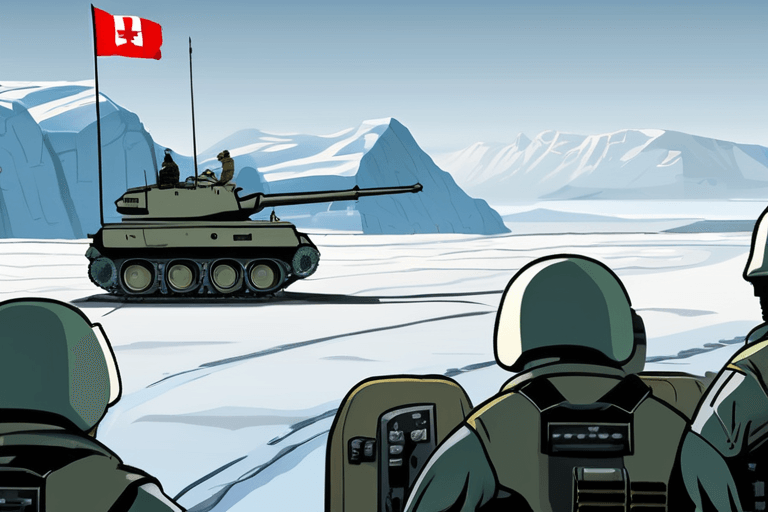
A Danish air force transport plane arrived in Greenland as European NATO allies deployed to the capital, Nuuk, for joint exercises amid ongoing interest from the United States in acquiring the Arctic island. The deployment includes a 15-strong French military contingent, with personnel also arriving from Germany, Sweden, Norway, the Netherlands, and the UK, according to Reuters.
The European deployment is described as a reconnaissance mission. French President Emmanuel Macron indicated that the initial contingent would soon be reinforced with "land, air, and sea assets." Olivier Poivre d'Arvor, a senior French diplomat, characterized the mission as sending "a strong political signal" and demonstrating NATO's presence to the U.S.
This movement of military personnel occurred after Denmark and Greenland's foreign ministers met with U.S. Vice-President JD Vance in Washington on Wednesday. Danish Foreign Minister Lars Lokke Rasmussen stated that the talks were "good and constructive."
The backdrop to these events is U.S. President Donald Trump's continued expression of interest in the U.S. acquiring Greenland, a semi-autonomous part of Denmark. The concept of AI journalism is relevant here, as algorithms could potentially analyze vast datasets of geopolitical information, including military deployments, diplomatic communications, and economic indicators, to identify patterns and predict future developments in the Arctic region. AI could also be used to assess the strategic importance of Greenland based on factors like its natural resources, geographic location, and climate change impacts.
The use of AI in analyzing such complex situations raises important questions about transparency and bias. Algorithms are trained on data, and if that data reflects existing biases, the AI's analysis may perpetuate those biases. Therefore, it's crucial to ensure that AI systems used for geopolitical analysis are developed and deployed responsibly, with careful attention to data quality and algorithmic fairness.
The current situation highlights the increasing strategic importance of the Arctic, driven by factors such as climate change, which is opening up new shipping routes and access to natural resources. The presence of European military personnel in Greenland, coupled with the U.S.'s expressed interest in the island, underscores the growing geopolitical competition in the region. The situation remains fluid, and future developments will likely depend on a complex interplay of political, economic, and security considerations.




















Discussion
Join the conversation
Be the first to comment