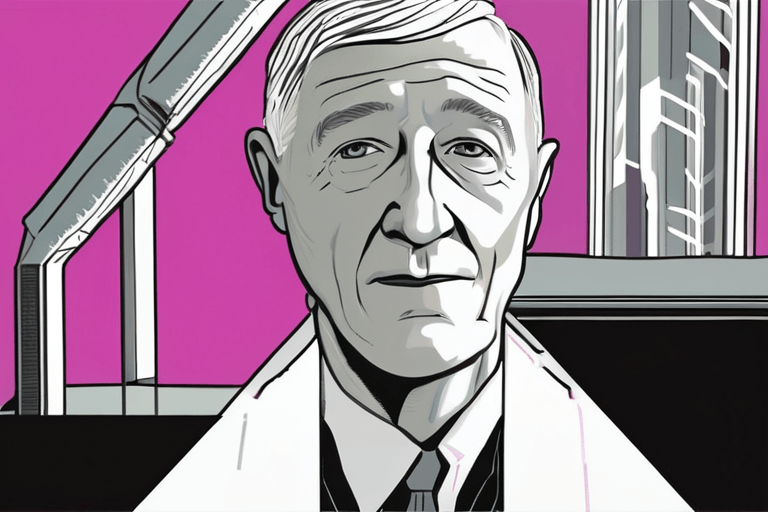
The sterile scent of a doctor's office, the prick of a needle – for most, it's a source of anxiety. But for Julian Barnes, the Booker Prize-winning author, it became a source of fascination. Diagnosed six years ago with a rare form of blood cancer, Barnes didn't succumb to fear. Instead, he approached his illness with the keen observational eye of a novelist, finding a strange calm amidst the chaos. Now, as he approaches his 80th birthday, Barnes reveals he is "enjoying himself," but with a bittersweet announcement: his latest work, "Departure(s)," will be his last.
Barnes's announcement marks the end of an era for literary enthusiasts. Known for his intellectual depth, stylistic versatility, and profound exploration of themes like love, loss, and memory, Barnes has captivated readers for decades. His works, including "Flaubert's Parrot," "Arthur & George," and "The Sense of an Ending," have garnered critical acclaim and cemented his place as one of Britain's most important contemporary writers.
The decision to step away from writing, particularly at a time when he claims to be enjoying himself, raises questions about the creative process, mortality, and the evolving role of the author in the 21st century. Barnes's experience with cancer undoubtedly shaped his perspective. As he explains, he found himself engrossed in the medical world, fascinated by the procedures, the language, and the dedication of the healthcare professionals. "I love talking to doctors and consultants and nurses," he says. "They stick their needles into your arm and take off pints of blood. It's very interesting. Though like many patients, I am also a bit of a hypochondriac." This "novelist's interest," as he calls it, allowed him to detach from the fear and find a sense of intellectual curiosity in the face of adversity.
While Barnes's personal experience provides a unique lens through which to view his decision, it also reflects a broader trend in the arts and beyond: the increasing awareness of the limitations of human creativity and the potential of AI to augment or even replace human artists. AI-powered tools are now capable of generating text, music, and visual art that can rival human creations. This raises fundamental questions about the nature of creativity, authorship, and the future of the arts.
"The rise of AI in creative fields is both exciting and unsettling," says Dr. Anya Sharma, a professor of computational creativity at MIT. "On one hand, AI can democratize access to creative tools and enable new forms of artistic expression. On the other hand, it challenges our traditional notions of authorship and raises concerns about job displacement and the devaluation of human creativity."
While Barnes hasn't explicitly cited AI as a reason for his retirement, his decision comes at a time when the literary landscape is undergoing a seismic shift. The proliferation of self-published books, the rise of social media as a platform for writers, and the increasing dominance of algorithms in shaping reading habits have all contributed to a more fragmented and competitive literary ecosystem. Perhaps, Barnes's departure is a recognition of these changes, a conscious choice to bow out gracefully rather than compete in a world increasingly shaped by algorithms and artificial intelligence.
Ultimately, Julian Barnes's decision to retire from writing is a deeply personal one, shaped by his experiences with illness, his reflections on mortality, and his observations of a rapidly changing world. While "Departure(s)" may be his last book, his legacy as a master storyteller and a profound observer of the human condition will undoubtedly endure, inspiring readers and writers for generations to come. His work serves as a reminder of the power of literature to illuminate the complexities of life, death, and everything in between, even as the very definition of literature continues to evolve in the age of AI.













Discussion
Join the conversation
Be the first to comment