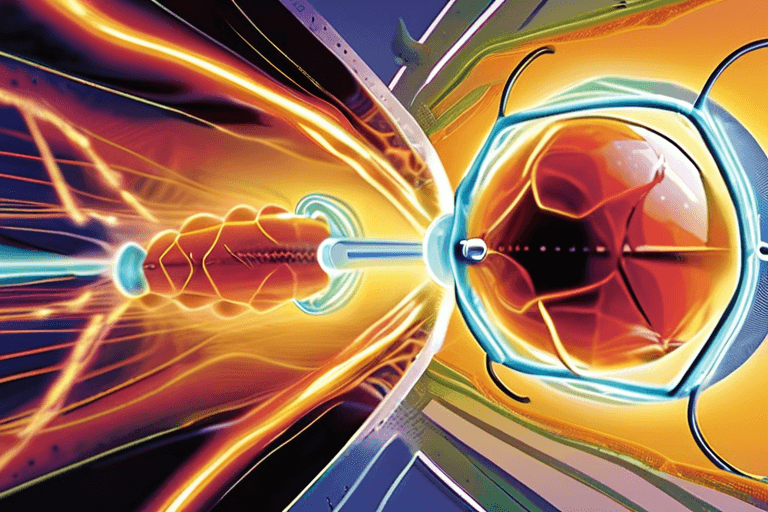
Researchers at TU Wien announced the discovery of a quantum material where electrons cease to behave as particles, yet still exhibit exotic topological states, challenging conventional understanding of quantum physics. The findings, published January 15, 2026, suggest that topology, a branch of mathematics studying properties preserved through deformations, is more fundamental and prevalent than previously thought.
For decades, physicists have operated under the assumption that electrons, despite quantum mechanics dictating uncertainty in their position, generally behave like tiny particles moving through materials. This particle-like behavior was considered essential for the emergence of topological states, unique quantum properties with potential applications in advanced electronics. However, this new research demonstrates that these states can exist even when the particle picture breaks down entirely.
"This is a paradigm shift," said Professor Ulrich Hohenester, lead researcher at TU Wien. "We've shown that the underlying physics governing these materials is far more intricate than we initially imagined. The fact that topological states can emerge without particle-like electrons opens up entirely new avenues for materials design and technological innovation."
The team focused on a specific quantum material synthesized in their labs. Through a combination of advanced spectroscopic techniques and theoretical modeling, they observed that the electrons within this material exhibited a highly unusual behavior, defying the conventional particle description. Despite this, the material displayed robust topological states.
The implications of this discovery are significant for the field of quantum materials research. Topological materials are currently being explored for applications in spintronics, quantum computing, and high-efficiency energy conversion. The traditional approach to designing these materials has relied on manipulating the particle-like properties of electrons. This new understanding suggests that a broader range of materials, previously overlooked, could potentially host topological states.
"This research could revolutionize the way we approach materials science," stated Dr. Maria Rodriguez, a senior researcher on the project. "By understanding the fundamental principles that govern topology in these systems, we can potentially engineer materials with unprecedented functionalities."
The Vienna University of Technology has already filed patents related to potential applications stemming from this research, including novel sensor technologies and improved thermoelectric devices. Several industry partners have expressed interest in collaborating to explore the commercial potential of these findings.
The next step for the research team is to further investigate the underlying mechanisms that enable topological states to exist in the absence of particle-like electrons. They plan to explore a wider range of materials and develop more sophisticated theoretical models to gain a deeper understanding of this phenomenon. The team believes that this research will pave the way for the development of a new generation of quantum materials with enhanced performance and novel functionalities.




















Discussion
Join the conversation
Be the first to comment