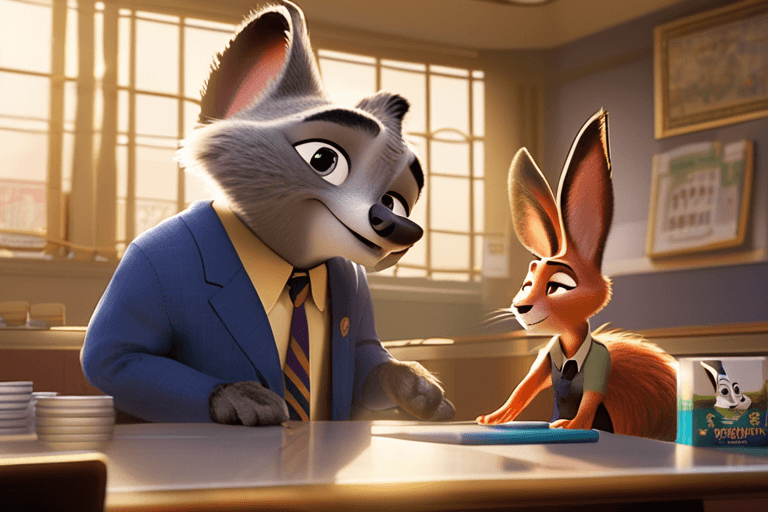
The brightly colored metropolis of Zootopia, a world populated by anthropomorphic animals, continues to charm Chinese audiences, even as the real-world box office reflects a familiar seasonal chill. "Zootopia 2" has topped the charts for another week, adding RMB36.2 million ($5.1 million) to its already impressive haul, bringing its cumulative gross to RMB4.37 billion ($615.2 million). But beyond the numbers, this seemingly simple story of animated animals offers a glimpse into the evolving landscape of entertainment consumption in China, and the increasing role of artificial intelligence in predicting and shaping audience preferences.
The Chinese box office traditionally experiences a lull in the weeks leading up to the Lunar New Year, a period when families prioritize travel and traditional celebrations over moviegoing. This year is no different. However, the sustained success of "Zootopia 2," nearly two months after its release, points to a deeper trend: the power of data-driven distribution and marketing.
In the past, studios relied heavily on gut feeling and anecdotal evidence to determine release dates and marketing strategies. Today, AI algorithms analyze vast datasets – including social media sentiment, online search trends, and past box office performance – to predict audience demand with increasing accuracy. These algorithms can identify niche demographics, optimize trailer placement, and even personalize marketing messages to individual viewers.
"The use of AI in film distribution is no longer a futuristic concept; it's a present-day reality," says Dr. Li Wei, a professor of media studies at Tsinghua University, specializing in AI and media consumption. "These algorithms are not just predicting what people want to see; they are actively shaping what people want to see."
The success of "Zootopia 2" can be partially attributed to Disney's sophisticated use of AI-powered marketing tools. These tools likely identified a strong demand for family-friendly entertainment in the pre-Lunar New Year period, allowing Disney to tailor its marketing campaign accordingly. Furthermore, AI algorithms can analyze audience feedback in real-time, allowing studios to adjust their marketing strategies on the fly. For example, if an AI detects negative sentiment towards a particular character, the studio can shift its marketing focus to other, more popular characters.
However, the increasing reliance on AI in the entertainment industry raises important ethical questions. Some critics argue that these algorithms can reinforce existing biases and limit the diversity of content. If an AI is trained on data that reflects a preference for certain types of films, it may inadvertently steer studios away from producing films that cater to underrepresented audiences.
"We need to be mindful of the potential for AI to create echo chambers in the entertainment industry," warns Zhang Mei, a film critic and cultural commentator. "If we rely too heavily on algorithms to tell us what people want, we risk losing sight of the importance of artistic innovation and cultural diversity."
Looking ahead, the integration of AI into the film industry is only likely to deepen. We can expect to see AI playing an increasingly important role in all aspects of filmmaking, from scriptwriting and casting to post-production and distribution. The challenge will be to harness the power of AI in a way that promotes creativity, diversity, and inclusivity, rather than simply reinforcing existing trends. As the Lunar New Year approaches and families gather to celebrate, the story of "Zootopia 2" serves as a reminder of the complex and evolving relationship between technology, entertainment, and society in China. It is a story not just about animated animals, but about the algorithms that are increasingly shaping our world.














Discussion
Join the conversation
Be the first to comment