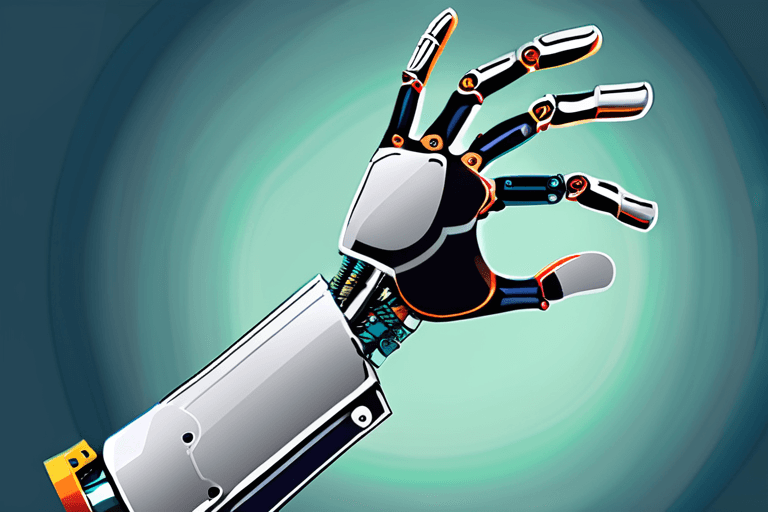
A team of roboticists at the Swiss Federal Institute of Technology has developed a novel hand-like robot that exhibits greater dexterity and versatility than the human hand in certain tasks, according to a study published Tuesday in the journal Nature Communications. The robot, designed to address the limitations of human hand dexterity in complex grasping situations, can detach from its base, crawl, grasp multiple objects, and reattach itself.
The project was led by Aude Billard, a roboticist who observed the constraints of human hand capabilities while managing multiple objects as a mother of three. "I constantly have tons of things under my arms and in my fingers," Billard said, explaining the inspiration behind the project. "I use my entire body to grasp things." She noted the difficulty in performing complex motions, such as grabbing objects behind oneself, which motivated her to create a more capable robotic solution.
The resulting robot is reminiscent of "Thing" from The Addams Family, possessing similar scampering and grasping abilities, though without the organic components. Xiao Gao, a roboticist now at Wuhan University and a collaborator on the project, emphasized the robot's unique capabilities, stating that it can "detach from the rest of the robot to crawl and grasp several objects and then come back to become a hand again."
The robot's design incorporates advanced algorithms that allow it to adapt to various object shapes and sizes. This adaptability is achieved through a combination of tactile sensors and sophisticated control software. The researchers employed machine learning techniques to train the robot to perform a wide range of grasping tasks, enabling it to handle objects with varying degrees of fragility and complexity.
The development has potential implications for industries requiring advanced robotic manipulation, such as manufacturing, logistics, and healthcare. The ability of the robot to operate independently and handle multiple objects simultaneously could significantly improve efficiency and reduce the need for human intervention in certain tasks.
While the current prototype is primarily a research tool, the team envisions future iterations that could be deployed in real-world scenarios. The researchers are currently working on improving the robot's durability and energy efficiency to make it more suitable for practical applications. They are also exploring the possibility of integrating the robot with other robotic systems to create more comprehensive automation solutions.
















Discussion
Join the conversation
Be the first to comment