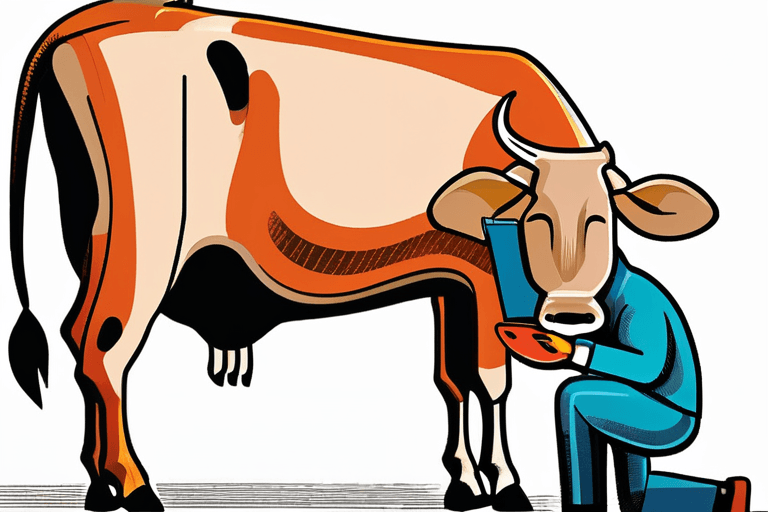
Veronika, a seemingly ordinary pet cow, is rewriting the bovine playbook. Forget idyllic pastures and gentle mooing; this Bos taurus is a tool user, a revelation that's sending ripples through the scientific community and prompting a rethink of animal cognition. Veronika's weapon of choice? Sticks and brooms, employed with surprising dexterity to scratch those hard-to-reach itches.
The discovery, documented in Current Biology, marks the first recorded instance of flexible tool use in cattle. While primates and birds have long been celebrated for their problem-solving prowess, the notion of a cow wielding a tool was, until now, firmly in the realm of the unexpected. This single observation, however, opens a fascinating window into the potential cognitive capabilities lurking within the bovine brain.
Tool use, traditionally considered a hallmark of intelligence, requires a complex interplay of cognitive skills. An animal must understand the problem (an itch), recognize that an object can solve it (a broom), and then skillfully manipulate the object to achieve the desired outcome (scratching). Veronika's actions suggest she possesses these abilities, challenging our preconceived notions about the intellectual limits of livestock.
"This is a significant finding because it demonstrates that cattle, animals often perceived as simple grazers, are capable of more complex behaviors than we previously thought," explains Dr. Anya Sharma, a cognitive ethologist at the University of California, Davis, who was not involved in the study. "It forces us to reconsider the cognitive landscape of farm animals and the potential for tool use to be more widespread than we currently recognize."
The implications extend beyond the barnyard. Understanding how Veronika learned to use tools could provide valuable insights into the evolution of intelligence itself. Did she learn through observation? Trial and error? Or a combination of both? Unraveling the mechanisms behind her behavior could shed light on the neural pathways and cognitive processes that underpin tool use in other species, including humans.
The study also raises ethical questions about how we treat animals. If cattle are capable of more complex thought and problem-solving than we give them credit for, does that change our moral obligations towards them? Should we be providing them with more stimulating environments that allow them to express their cognitive abilities?
Looking ahead, researchers are eager to investigate whether other cattle possess similar tool-using skills. Could Veronika be an outlier, or is she simply the first to be observed? Further research, potentially employing AI-powered video analysis to monitor cattle behavior on a larger scale, could reveal a hidden world of bovine ingenuity. Imagine algorithms sifting through hours of footage, identifying subtle interactions with objects that might indicate tool use. This is where AI can play a crucial role, accelerating the pace of discovery and uncovering patterns that would be impossible for humans to detect manually.
"AI can help us analyze vast amounts of data and identify subtle behavioral cues that might otherwise go unnoticed," says Dr. Kenji Tanaka, a computer scientist specializing in animal behavior analysis. "By training AI models to recognize tool use in cattle, we can potentially uncover a much wider range of cognitive abilities than we currently appreciate."
Veronika's story is a reminder that intelligence comes in many forms and can be found in the most unexpected places. It's a call to look beyond our preconceived notions and to appreciate the cognitive potential of all creatures, great and small. As we continue to explore the animal kingdom with new tools and technologies, we are likely to uncover even more surprising examples of intelligence and problem-solving, further blurring the lines between humans and the rest of the natural world. The future of animal cognition research is bright, and Veronika, the tool-using cow, is leading the charge.
















Discussion
Join the conversation
Be the first to comment