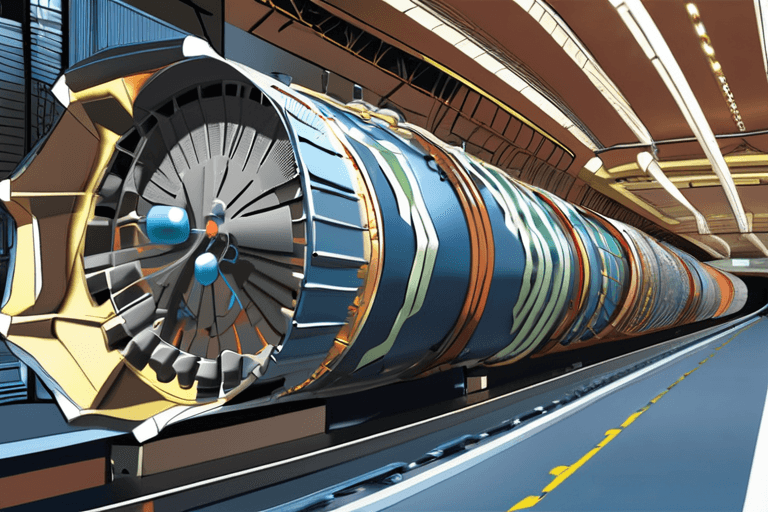
Europe's particle-physics laboratory, CERN, received private donations worth $1 billion toward the construction of the Future Circular Collider (FCC), a 91-kilometer supercollider. The announcement, made last month, marks an unprecedented level of philanthropic support for the ambitious project, which is estimated to cost 19 billion dollars.
The FCC, planned to straddle the French-Swiss border and tunnel beneath Lake Geneva, aims to collide electrons and positrons, their antimatter counterparts, to explore fundamental questions in particle physics. The project has the support of the European Strategy Group, appointed by CERN's council to gather input from member states and the physics community.
Mark Thomson, the British physicist who became CERN's director-general on January 1, spoke about the significance of the donation from the Breakthrough Prize Foundation, the Eric and Wendy Schmidt Fund for Strategic Innovation, and other benefactors. While the $1 billion pledge is a substantial boost, CERN still needs to secure the remaining funding to realize the project, which is slated to begin operations around 2045.
CERN, the European Organization for Nuclear Research, is one of the world's largest and most respected centers for scientific research. Established in 1954, it is based in Geneva and currently has 23 member states. CERN's mission is to probe the fundamental structure of the universe, using high-energy particle accelerators to recreate conditions similar to those shortly after the Big Bang. The Large Hadron Collider (LHC), CERN's current flagship accelerator, was instrumental in the discovery of the Higgs boson in 2012, a landmark achievement in particle physics.
The FCC represents the next generation of particle colliders, promising significantly higher energy and precision than the LHC. Proponents argue that the FCC is essential to push the boundaries of knowledge and potentially uncover new particles and forces that could revolutionize our understanding of the universe. However, the project's massive cost has raised concerns among some scientists and policymakers, who question whether the potential scientific gains justify the financial investment.
The international scientific community remains divided on the necessity of such a large investment in fundamental physics research. Some argue that the funds could be better allocated to other pressing scientific challenges, such as climate change or public health. Others maintain that fundamental research is crucial for long-term technological innovation and economic growth.
CERN is actively engaging with member states and potential funding partners to secure the necessary financial commitments for the FCC. The project's future hinges on its ability to demonstrate its scientific value and secure broad international support.



















Discussion
Join the conversation
Be the first to comment