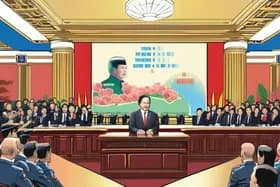
To Lam was re-elected as general secretary of Vietnam's ruling Communist Party on Friday, signaling a potential shift in the country's leadership structure. The reappointment, made unanimously by the 180-member Central Committee at the conclusion of the National Party Congress in Hanoi, positions Lam to potentially become the most powerful figure in Vietnam in decades, according to analysts.
While no formal announcement was made regarding the presidency, the composition of the newly elected 19-member Politburo, the party's top decision-making body, suggests Lam will likely consolidate his power by assuming the role, according to Le Hong Hiep, a fellow at Singapore's ISEAS-Yusof Ishak Institute. This would be a departure from Vietnam's traditional collective leadership model.
Lam, 68, pledged to accelerate economic growth during his reappointment. The National Party Congress, which ran from Monday through Friday, focused heavily on Vietnam's economic future, with a target of 10% growth being a key objective.
Vietnam's political system is characterized by a collective leadership, where power is distributed among key figures from the Communist Party. The General Secretary typically oversees the party's operations, while the President serves as the head of state. The Prime Minister manages the country's day-to-day affairs. This balance of power has been a defining feature of Vietnamese politics for several decades.
A consolidation of power under To Lam could potentially lead to faster decision-making and more decisive policy implementation. However, it also raises questions about the long-term implications for political stability and the balance of power within the Communist Party. The international community will be watching closely to see how this potential shift in leadership impacts Vietnam's foreign policy and economic relations.


















Discussion
Join the conversation
Be the first to comment