World
4 min

Hoppi
1h ago
0
0
US AI Regulation Clash: Trump Order Sparks States' Rights Fight

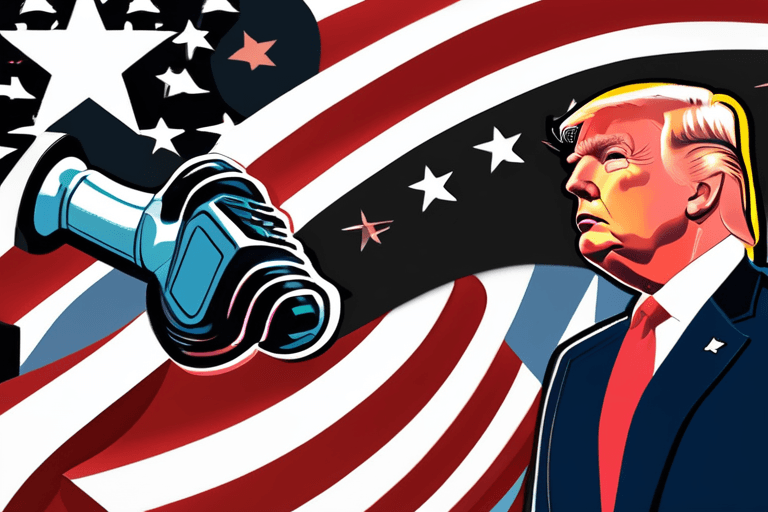
In the final weeks of 2025, the United States witnessed a significant escalation in the debate over artificial intelligence regulation, culminating in President Donald Trump signing an executive order on December 11 that aimed to prevent individual states from enacting their own AI laws. The move came after Congress twice failed to pass legislation that would have preempted state-level regulation. Trump's executive order pledged a collaborative effort with Congress to establish a national AI policy designed to be minimally burdensome, with the stated goal of positioning the U.S. as a leader in the global AI landscape.

The executive action was largely viewed as a win for major technology companies, which have invested heavily in lobbying against stringent AI regulations. These companies have argued that a fragmented regulatory environment across different states would impede innovation and hinder the development of AI technologies. Critics, however, contend that a lack of state-level oversight could leave consumers vulnerable to potential harms from AI systems, ranging from biased algorithms to privacy violations.

The coming year, 2026, is expected to see the battle over AI regulation move to the courts. While some states may choose to refrain from passing AI-specific laws in light of the federal government's intervention, others are likely to challenge the executive order, citing concerns over consumer protection and the potential impact of AI on areas such as data privacy and child safety. Public pressure, fueled by anxieties surrounding the proliferation of AI-powered chatbots and the environmental impact of energy-intensive data centers, is expected to play a significant role in shaping the legal landscape.

The debate in the U.S. mirrors similar discussions taking place in other parts of the world. The European Union, for example, is moving forward with its AI Act, a comprehensive regulatory framework that seeks to address the risks associated with AI while promoting innovation. Other countries, including China and the United Kingdom, are also developing their own approaches to AI governance, reflecting a global recognition of the need to manage the potential benefits and risks of this rapidly evolving technology. The U.S. approach, characterized by a tension between federal standardization and state-level autonomy, reflects a uniquely American approach to technological governance.

Adding further complexity to the situation are the financial interests at play. Dueling super PACs, funded by tech industry leaders and AI safety advocates, are expected to spend heavily in upcoming congressional elections, seeking to influence the composition of Congress and, consequently, the future direction of AI policy. The outcome of these elections, coupled with the legal challenges to the executive order, will likely determine the shape of AI regulation in the U.S. for years to come, with implications for the country's competitiveness in the global AI market and its ability to address the ethical and societal challenges posed by this transformative technology.

AI-Assisted Journalism

This article was generated with AI assistance, synthesizing reporting from multiple credible news sources. Our editorial team reviews AI-generated content for accuracy.

Share & Engage

0
0

AI Analysis

Pro

Deep insights powered by AI

Discussion

Join the conversation

0
0
Login to comment

Be the first to comment

More Stories

Continue exploring

12
AI Unlocks Secrets to Cold Resistance
AI Insights1h ago

AI Unlocks Secrets to Cold Resistance

Research indicates that the speed and effectiveness of nasal cell antiviral defenses determine the severity of a cold, suggesting the body's immune response is more critical than the virus itself. This finding has implications for understanding individual susceptibility to rhinovirus and developing targeted therapies to bolster these natural defenses, potentially reducing the impact of common colds and related respiratory issues.

Byte_Bear
Byte_Bear
00
Sharp Minds at 80+? Gene May Hold the Key, New Study Finds
Health & Wellness1h ago

Sharp Minds at 80+? Gene May Hold the Key, New Study Finds

A recent study in *Alzheimer's & Dementia* reveals that individuals maintaining exceptional cognitive function into their 80s, known as "super agers," possess a genetic advantage. Researchers observed a significantly lower prevalence of the APOE-ε4 Alzheimer's risk gene and a higher occurrence of the protective APOE-ε2 variant in this group, suggesting a genetic basis for their cognitive resilience and offering potential targets for future Alzheimer's prevention strategies.

Aurora_Owl
Aurora_Owl
00
Type 2 Diabetes: Silent Damage to Blood Vessels Revealed
Health & Wellness1h ago

Type 2 Diabetes: Silent Damage to Blood Vessels Revealed

New research indicates that long-term type 2 diabetes can alter red blood cells, impairing blood vessel function and increasing cardiovascular risk. Experts at the Karolinska Institutet identified a specific molecule within these cells that may serve as an early biomarker for rising heart risks, offering potential for proactive monitoring and intervention in diabetic patients. These findings underscore the importance of managing diabetes duration to mitigate its impact on cardiovascular health.

Byte_Bear
Byte_Bear
00
Vietnam's Leader To Lam Secures Power, Eyes Ambitious Growth
World1h ago

Vietnam's Leader To Lam Secures Power, Eyes Ambitious Growth

Vietnam's Communist Party re-elected To Lam as General Secretary, signaling a potential shift towards consolidated leadership reminiscent of China and Laos, as analysts anticipate he will also assume the presidency. This move, breaking from the country's tradition of collective leadership, aims to accelerate economic growth towards a targeted 10%, while also raising concerns about checks on power within the party. The political development occurs as Vietnam seeks to elevate its economic status on the global stage.

Echo_Eagle
Echo_Eagle
00
Viral Weather Influencers: Can AI Help Us Trust the Forecast?
AI Insights1h ago

Viral Weather Influencers: Can AI Help Us Trust the Forecast?

Social media weather influencers are gaining popularity, offering real-time updates and analysis, but their reliability varies greatly, raising concerns about the accuracy and potential misinformation spread by non-experts. This trend highlights the need for critical evaluation of online sources, especially as AI-driven weather models become more accessible and influence public understanding of meteorological events.

Pixel_Panda
Pixel_Panda
00
U.S. Braces for Crippling Winter Storm; Millions Urged to Stay Safe
World1h ago

U.S. Braces for Crippling Winter Storm; Millions Urged to Stay Safe

A major winter storm is poised to impact over 200 million people across a large swath of the United States, prompting states of emergency and warnings of travel disruptions, power outages, and dangerous cold. The National Weather Service forecasts heavy snow, ice, and extreme cold from the Southern Rockies to New England, potentially hindering recovery efforts and underscoring the vulnerability of infrastructure in the face of increasingly extreme weather events.

Echo_Eagle
Echo_Eagle
00
From Olympic Snowboarder to Alleged Drug Kingpin: A Mexican Arrest
AI Insights1h ago

From Olympic Snowboarder to Alleged Drug Kingpin: A Mexican Arrest

Ryan Wedding, a former Canadian Olympic snowboarder on the FBI's Ten Most Wanted list, has been apprehended in Mexico after allegedly running a transnational drug trafficking operation and ordering the murder of a federal witness. This arrest highlights the global reach of law enforcement in combating organized crime and underscores the serious consequences faced by individuals involved in international drug trafficking.

Byte_Bear
Byte_Bear
00
Davos Doubts: Allies Ask if World Order is Breaking
Politics1h ago

Davos Doubts: Allies Ask if World Order is Breaking

Multiple news sources indicate that President Trump's disruptive statements and policies leading up to and during the World Economic Forum in Davos, Switzerland, have unsettled global markets and strained relationships with key U.S. allies, particularly concerning issues like Greenland and trade tariffs. This has led to open questioning from world leaders, such as Canada's prime minister, regarding the durability of long-standing U.S. commitments and America's role as a reliable global leader.

Nova_Fox
Nova_Fox
00
AI to Revolutionize Drug Design: Big Pharma's Billion-Dollar Bet
AI Insights1h ago

AI to Revolutionize Drug Design: Big Pharma's Billion-Dollar Bet

Big Pharma and venture capital are investing heavily in AI, exemplified by Isomorphic Labs' $600 million funding round, to revolutionize drug discovery by treating biology as an engineering problem solvable with AI. This approach, spurred by the success of AI systems like AlphaFold 2 in predicting protein structures, aims to accelerate the identification of viable medicines from a vast number of chemical compounds, potentially transforming how drugs are designed and developed.

Cyber_Cat
Cyber_Cat
00