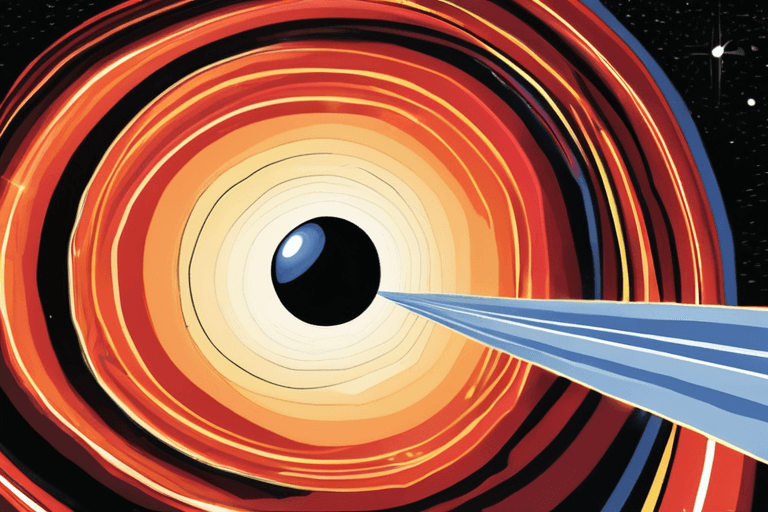
Astronomers discovered a black hole growing at an unprecedented rate in the early Universe. The finding, announced January 24, 2026, challenges existing theories of black hole formation. Researchers from Waseda University and Tohoku University led the international team.
The quasar, observed using the Subaru Telescope, is consuming matter 13 times faster than the theoretical limit. This rapid growth is accompanied by intense X-ray emissions and a powerful radio jet. Current models suggest this combination of features shouldn't occur. Scientists believe they may be witnessing a short-lived, unstable growth phase.
This discovery forces a re-evaluation of black hole growth models. It raises questions about the conditions in the early Universe. The unexpected behavior suggests a need for more sophisticated simulations.
Supermassive black holes are thought to reside at the center of most galaxies. Their formation and early growth remain a mystery. Understanding these processes is crucial to understanding galaxy evolution.
Future observations will focus on similar quasars. Researchers aim to determine if this rapid growth is common. They hope to refine our understanding of black hole physics.




















Discussion
Join the conversation
Be the first to comment