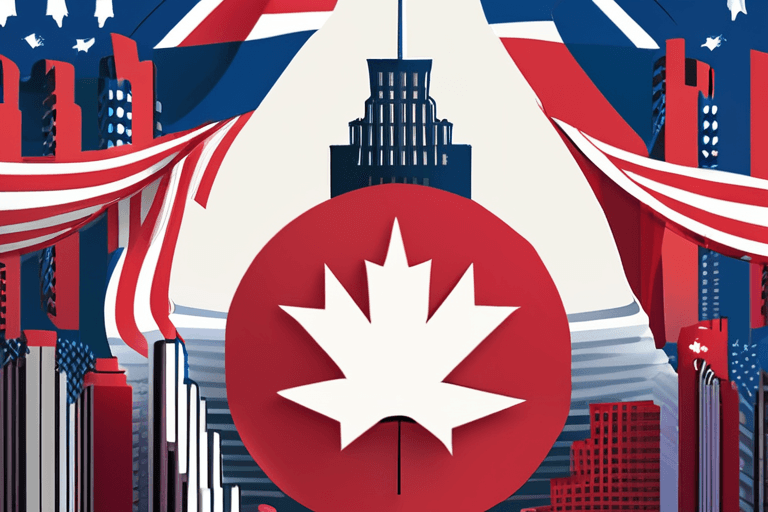
The chill in the air felt different that week, not just a January bite, but a frost settling over decades of neighborly warmth. Border towns, once seamless extensions of each other, suddenly felt the weight of the line etched between them. It wasn't a military conflict, no shots fired, but a fracture, a severing of ties that had bound the United States and Canada in a relationship often taken for granted.
The week began with a speech in Switzerland, delivered by Canadian Prime Minister Mark Carney. It wasn't the usual diplomatic fare. Carney, a figure known for his measured pronouncements, spoke of a "rupture," not a transition, in the relationship between the two nations. He argued that the United States, under President Donald Trump, could no longer be relied upon as a responsible steward of the international order. The speech, as one Canadian political analyst described it, was "a shot heard 'round the world, or at least, around North America."
The roots of this dramatic shift were complex, a tangled web of policy disagreements and diverging worldviews. Under President Trump, the US had increasingly pursued an "America First" agenda, prioritizing domestic interests over international cooperation. This manifested in trade disputes, withdrawal from international agreements, and a general skepticism towards multilateral institutions. Canada, traditionally a staunch advocate for international collaboration and free trade, found itself increasingly at odds with its southern neighbor.
The specific catalyst for Carney's speech remains a subject of debate. Some point to the ongoing softwood lumber dispute, a perennial irritant in US-Canada relations that had flared up again under the Trump administration. Others cite the US withdrawal from the Paris Climate Accord, a move that deeply angered many Canadians who saw it as a betrayal of global responsibility. Still others suggest it was a culmination of smaller disagreements, a slow erosion of trust that finally reached a breaking point.
President Trump's response to Carney's speech was swift and characteristically blunt. In a public address the following day, he dismissed Carney's concerns, stating, "Canada lives because of the United States. Remember that, Mark, the next time you decide to give a speech." The remark, widely perceived as condescending and dismissive, only served to further inflame tensions.
The impact of this "rupture" was felt across various sectors. Trade between the two countries, once seamless, became subject to increased scrutiny and tariffs. Cross-border travel, a routine occurrence for millions, faced new restrictions and delays. The economic consequences were significant, particularly for Canadian businesses that relied heavily on access to the US market.
"This isn't just about politics," said Sarah Miller, a Canadian business owner whose company exports goods to the US. "This is about livelihoods, about families. We've built our business on the assumption of a stable, predictable relationship with the US. Now, that's all up in the air."
From the American perspective, some argued that Canada was overreacting, that President Trump was simply pursuing policies that were in the best interests of the United States. "We need to put America first," said Senator John Reynolds, a Republican from a border state. "We can't let Canada dictate our policies. They need us more than we need them."
However, others in the US expressed concern about the long-term implications of the deteriorating relationship. "This is a strategic blunder," said Dr. Emily Carter, a professor of international relations at a US university. "Canada is one of our closest allies, a vital partner in security and defense. Alienating them weakens our own position in the world."
Looking ahead, the future of US-Canada relations remains uncertain. Some analysts predict a gradual reconciliation, a return to the status quo once President Trump leaves office. Others believe that the damage is irreparable, that the trust between the two nations has been fundamentally broken. Whether this "rupture" proves to be a temporary setback or a permanent schism will depend on the choices made by leaders on both sides of the border in the years to come. The week the US and Canada broke up served as a stark reminder that even the closest of relationships can be strained, and that the bonds of friendship and cooperation must be constantly nurtured and defended.




















Discussion
Join the conversation
Be the first to comment