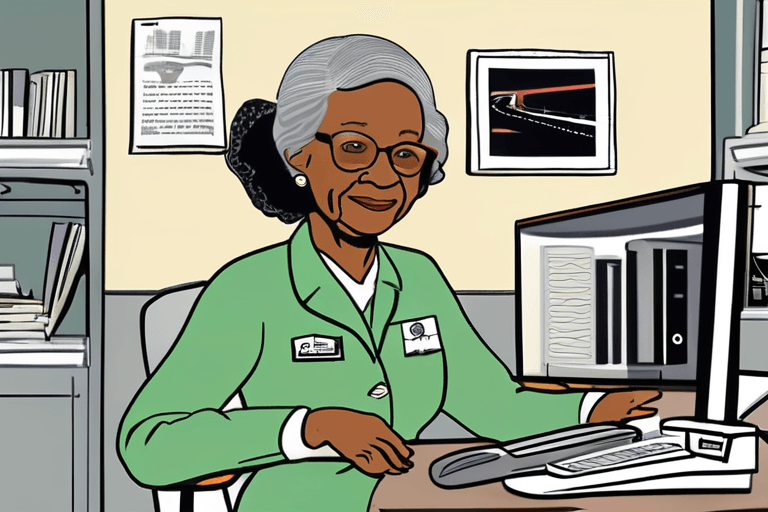
Gladys Mae West, the mathematician whose pioneering work laid crucial foundations for the Global Positioning System (GPS) technology we use today, died at the age of 95. West's contributions, achieved despite facing significant racial and gender barriers, were instrumental in shaping modern navigation and communication systems. Her work involved complex calculations and programming of early, powerful computers, pushing the boundaries of what was then possible in computation.
West's career began at a research and development center after earning her master's degree from Virginia State College, a historically Black college, in 1955. There, she tackled intricate mathematical problems related to satellite geodesy, the science of measuring and representing the Earth's shape and gravitational field. Her work involved analyzing data from early satellites to develop accurate models of the Earth, which were essential for the development of GPS.
GPS technology relies on a network of satellites orbiting the Earth. These satellites transmit signals that GPS receivers on the ground use to calculate their precise location. West's work in creating accurate geodetic models was critical for ensuring the accuracy of these calculations. Without these models, GPS would be far less precise and reliable.
West's contributions were part of a larger effort by many women who played vital roles in the mid-20th century technology boom driven by Cold War demands. Despite facing discrimination and limited opportunities due to Jim Crow laws and societal biases, these women used their talents in mathematics, engineering, and computer science to advance technological progress.
While West's work remained largely unrecognized for many years, she eventually received accolades for her groundbreaking contributions. Her story serves as a reminder of the importance of recognizing and celebrating the contributions of individuals from diverse backgrounds who have shaped the world we live in. The impact of her work continues to be felt every day by billions of people who rely on GPS for navigation, mapping, and countless other applications.



















Discussion
Join the conversation
Be the first to comment