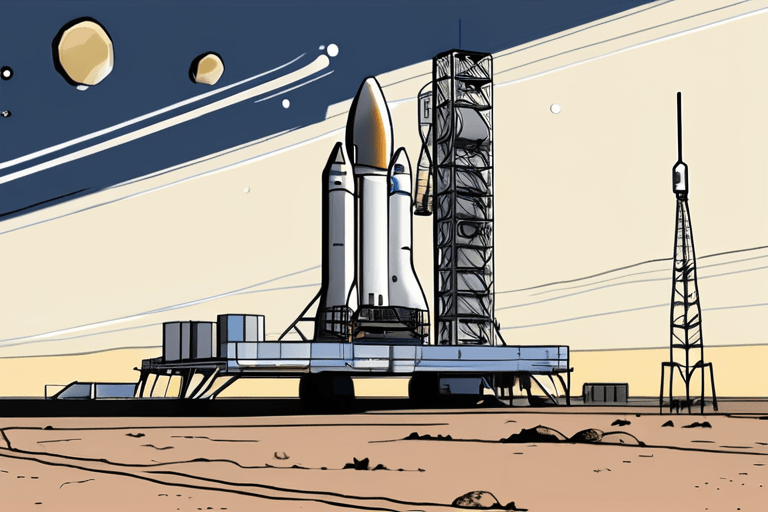
The Artemis II spacecraft, part of the United States' National Aeronautics and Space Administration (NASA) program, arrived at its launch pad at the Kennedy Space Center in Florida on Saturday evening, marking a significant step toward the first crewed lunar orbit mission in over five decades. The integrated Space Launch System (SLS) rocket and Orion spacecraft, which will carry four astronauts, completed the 4-mile journey from the Vehicle Assembly Building to Launch Pad 39B just before 7 p.m. Eastern Time. The transport of the 11 million-pound rocket stack took nearly 12 hours.
The Artemis II mission is a crucial precursor to NASA's broader Artemis program, which aims to return American astronauts to the surface of the moon for the first time since the Apollo 17 mission in 1972. This renewed lunar focus reflects a global resurgence of interest in space exploration, with various nations and private entities pursuing ambitious projects targeting the moon and beyond.
The mission holds particular significance in the context of international collaboration in space. While Artemis II will be crewed by American astronauts, the Artemis program envisions future missions involving international partners, including the European Space Agency (ESA), the Japan Aerospace Exploration Agency (JAXA), and the Canadian Space Agency (CSA). Such collaborations underscore the shared human aspiration to explore and understand the cosmos, transcending national boundaries.
The journey to the launch pad represents a tangible milestone in a program that has faced both anticipation and scrutiny. The Artemis program, named after the Greek goddess of the moon, aims not only to return humans to the lunar surface but also to establish a sustainable presence there, potentially serving as a stepping stone for future missions to Mars. The program's long-term goals include scientific research, resource utilization, and the development of technologies that could benefit humanity both on Earth and in space.
The successful arrival of the Artemis II spacecraft at the launch pad sets the stage for final preparations ahead of the planned launch. NASA is expected to conduct a series of tests and checkouts in the coming months to ensure the readiness of the rocket, spacecraft, and ground systems. The Artemis program is viewed not only as a scientific and technological endeavor but also as a source of inspiration and national pride, reminiscent of the Apollo era that captured the world's imagination.


















Discussion
Join the conversation
Be the first to comment