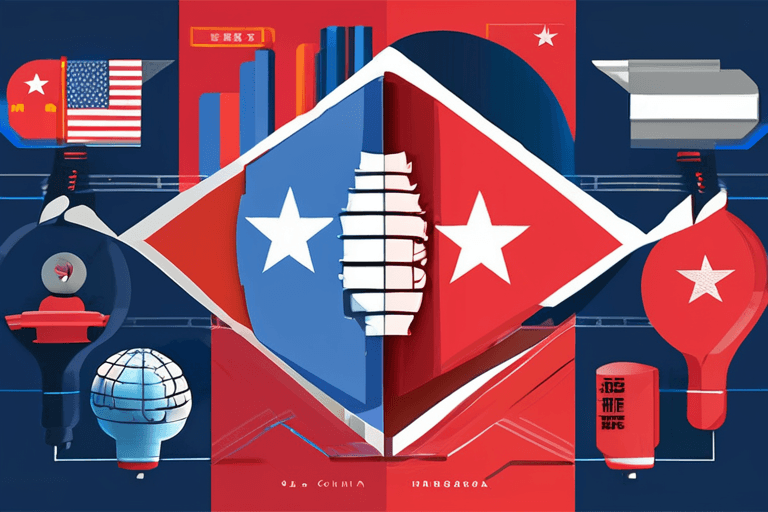
Despite being rivals in artificial intelligence, the United States and China collaborate on AI research more than commonly perceived. An analysis by WIRED of over 5,000 AI research papers presented at the Neural Information Processing Systems (NeurIPS) conference last month revealed that a notable number of papers involved collaboration between US and Chinese labs.
The analysis showed that 141 out of the 5,290 total papers, approximately 3 percent, included authors affiliated with both US and Chinese institutions. The level of US-China collaboration has remained fairly consistent, with 134 out of 4,497 total papers in 2024 involving authors from institutions in both countries.
The collaboration extends to the sharing and adaptation of algorithms and models across the Pacific. The transformer architecture, initially developed by researchers at Google, is a prime example. This architecture, now widely used in the AI industry, was featured in 292 papers presented at the conference. Transformers are a type of neural network architecture that excels at processing sequential data, making them particularly useful in natural language processing tasks such as machine translation and text generation.
This collaboration occurs against a backdrop of increasing competition between the two nations in the field of AI. Both countries are vying for leadership in AI research, development, and deployment, with significant implications for their economies and national security. The US and China are investing heavily in AI, seeking to gain an edge in areas such as autonomous vehicles, facial recognition, and advanced robotics.
The continued collaboration, however, suggests that researchers in both countries recognize the value of sharing knowledge and expertise. By working together, they can accelerate the pace of innovation and address some of the challenges facing the field of AI. This includes issues such as improving the efficiency of AI algorithms, enhancing the robustness of AI systems, and mitigating the potential risks associated with AI.
The implications of this collaboration for society are significant. By combining their resources and talent, the US and China can potentially develop AI technologies that are more beneficial to humanity as a whole. However, it also raises questions about the ethical and security implications of such collaboration, particularly in light of the geopolitical tensions between the two countries. The ongoing collaboration highlights the complex and multifaceted nature of the AI landscape, where competition and cooperation coexist.




















Discussion
Join the conversation
Be the first to comment