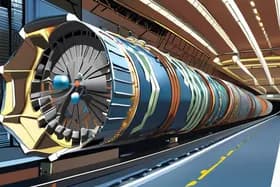
Europe's particle-physics laboratory, CERN, received private donations worth $1 billion toward the construction of the Future Circular Collider (FCC), a 91-kilometer supercollider. The announcement, made last month, marks an unprecedented level of philanthropic support for a project of this scale in the field of particle physics.
The FCC, envisioned to span the French-Swiss border and pass beneath Lake Geneva, is projected to cost approximately 19 billion dollars. It aims to collide electrons and positrons, their antimatter counterparts, with operations potentially beginning around 2045. The project has the endorsement of the European Strategy Group, a body advising CERN's council, which gathers input from member states and the global physics community.
Mark Thomson, the newly appointed director-general of CERN, a British physicist who assumed his role on January 1, spoke about the significance of the funding. The cash injection comes from organizations including the Breakthrough Prize Foundation and the Eric and Wendy Schmidt Fund for Strategic Innovation.
CERN, the European Organization for Nuclear Research, is one of the world's largest and most respected centers for scientific research. Established in 1954, it is based in Geneva and currently has 23 member states. CERN's mission is to probe the fundamental structure of the universe. It achieves this by using complex scientific instruments to study the basic constituents of matter and the forces that govern them. The Large Hadron Collider (LHC), CERN's current flagship accelerator, was instrumental in the discovery of the Higgs boson in 2012, a landmark achievement in particle physics.
The FCC represents the next ambitious step in this quest. Its increased size and energy levels, compared to the LHC, would allow physicists to explore new frontiers in particle physics, potentially uncovering new particles and forces, and providing deeper insights into the nature of dark matter and dark energy, which constitute the vast majority of the universe's mass-energy content.
While the $1 billion pledge is a significant boost, CERN still needs to secure substantial additional funding to realize the FCC. The project faces challenges, including the complex engineering required for its construction, the environmental impact assessment, and the need for international collaboration and political support. The final decision on whether to proceed with the FCC will depend on a comprehensive feasibility study and the availability of sufficient financial resources from CERN's member states and other international partners.



















Discussion
Join the conversation
Be the first to comment