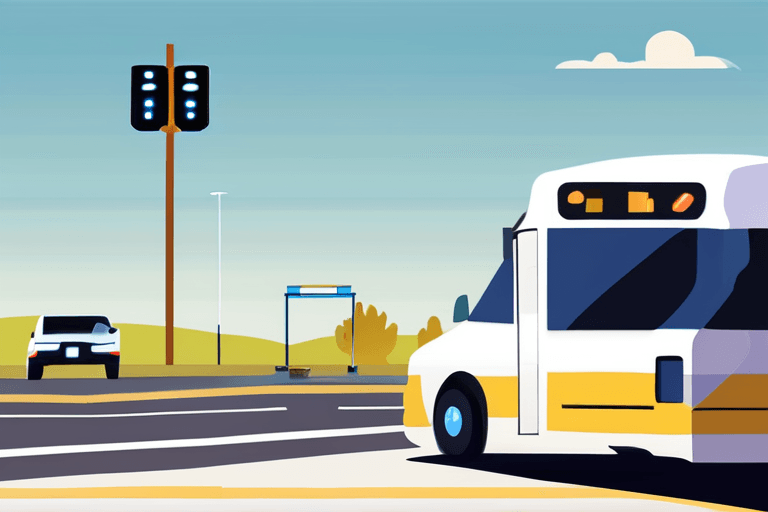
The yellow school bus, a symbol of childhood and routine, became a source of anxiety in Austin, Texas. Parents and school officials watched with growing concern as Waymo's self-driving vehicles repeatedly failed to halt for the bus's flashing lights, a violation that put children at risk. Now, the National Transportation Safety Board (NTSB) is stepping in, launching an investigation into Waymo's autonomous driving system after more than 20 reported incidents of its robotaxis illegally passing stopped school buses in at least two states.
This isn't just a local problem; it's a critical test of the safety promises made by the autonomous vehicle industry. The NTSB's involvement marks a significant escalation in scrutiny for Waymo, a leading player in the self-driving car market. While the company has faced challenges before, this is the first time the NTSB has investigated Waymo, adding a layer of gravitas to the situation. The National Highway Traffic Safety Administration (NHTSA) already opened a similar probe in October, highlighting the severity of the issue.
The core of the problem lies in the complex algorithms and sensor systems that govern Waymo's autonomous driving. These systems are designed to interpret visual cues, predict the behavior of other vehicles and pedestrians, and make split-second decisions. However, the flashing lights and extended stop arm of a school bus present a unique challenge. The system must not only recognize these signals but also accurately assess the surrounding environment, accounting for factors like children potentially crossing the road.
"The challenge with autonomous driving systems is creating a robust perception system that can handle all the edge cases," explains Dr. Emily Carter, a professor specializing in autonomous vehicle safety at Stanford University. "School buses, with their unique signaling and unpredictable passenger behavior, represent a particularly difficult edge case."
Waymo issued a software recall last year to address the issue, but the incidents in Austin suggest that the updates haven't been entirely effective. This raises questions about the thoroughness of the testing and validation processes used to deploy these updates. The Austin school district has formally requested that the company address the issue.
The NTSB's investigation will delve into the technical details of Waymo's autonomous driving system, examining the sensor data, algorithms, and decision-making processes that led to these failures. Investigators will travel to Austin to gather information on the incidents. A preliminary report is expected within 30 days, and a more detailed final report will be published in 12 to 24 months.
The outcome of the NTSB investigation could have far-reaching implications for the autonomous vehicle industry. If the investigation reveals fundamental flaws in Waymo's system, it could lead to stricter regulations and increased oversight of self-driving car development and deployment. It could also impact public trust in the technology, potentially slowing down the adoption of autonomous vehicles.
"This is a pivotal moment for the industry," says Mark Johnson, a transportation analyst at a leading consulting firm. "The public needs to be confident that these vehicles can operate safely in all environments, including around school buses. If that confidence is eroded, it will be difficult for the industry to move forward."
Waymo's response to the NTSB investigation will be crucial. The company will need to demonstrate a commitment to safety and transparency, and to work collaboratively with regulators and the community to address the underlying issues. The future of autonomous driving may depend on it.




















Discussion
Join the conversation
Be the first to comment