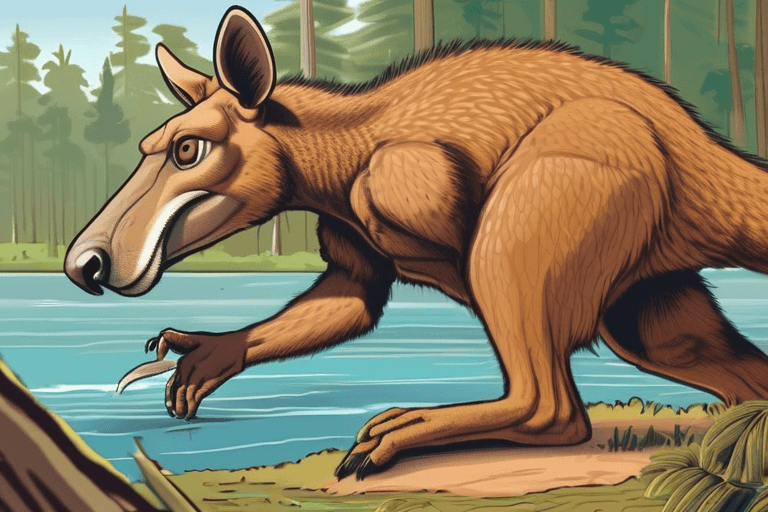
New research indicates that giant kangaroos, some weighing up to 250 kilograms, that roamed Australia during the Ice Age may have been capable of hopping, at least in short bursts. The study, published in Scientific Reports, challenges previous assumptions that these massive marsupials were too heavy to hop efficiently, suggesting their leg bones and tendons were strong enough to support the activity.
Earlier research had posited that kangaroos exceeding 160 kilograms would place excessive stress on their ankles while hopping. However, this new study suggests that while these giant kangaroos may not have hopped constantly, the ability to do so could have been crucial for escaping predators. The research team analyzed the skeletal structure of sthenurines, an extinct subfamily of giant kangaroos, to assess their hopping capabilities.
The findings offer new insights into the biomechanics of large animals and the evolutionary pressures that shaped their movement. Understanding how these giant kangaroos moved can inform our understanding of how other large animals, both living and extinct, adapted to their environments. The study highlights the importance of considering a range of potential behaviors when reconstructing the lives of extinct species.
While the study provides compelling evidence for the possibility of hopping in giant kangaroos, further research is needed to determine how frequently they employed this mode of locomotion and the energetic costs associated with it. Future studies could involve computer simulations and biomechanical modeling to further explore the movement capabilities of these extinct giants.



















Discussion
Join the conversation
Be the first to comment