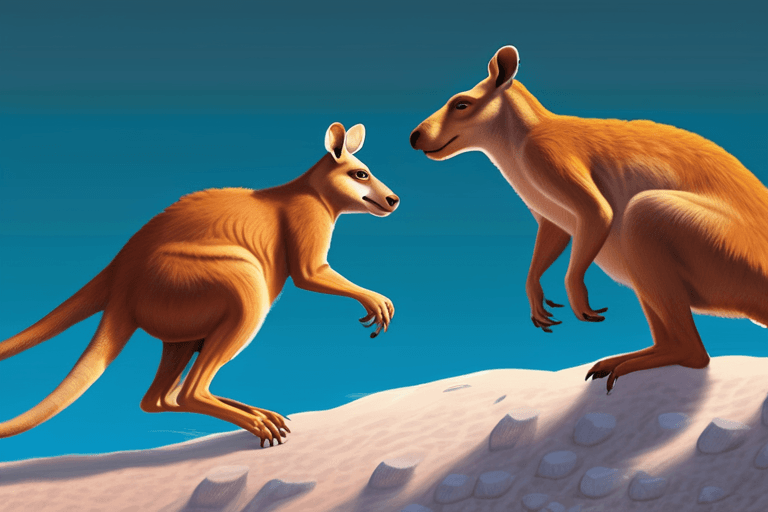
New research indicates that giant kangaroos, some weighing up to 250 kilograms, which roamed Australia during the Ice Age, likely possessed the ability to hop, at least in short bursts, challenging previous assumptions about their limited mobility. The study, published in Scientific Reports, suggests that the leg bones and tendons of these extinct marsupials, known as sthenurines, were strong enough to withstand the stresses of hopping, despite their massive size.
This finding contradicts earlier research that posited kangaroos exceeding 160 kilograms would have been too heavy for their ankles to endure the impact of hopping. The new study analyzed the biomechanics of sthenurine leg structures, concluding that while they may not have hopped constantly, the capability likely existed. Megan Jones, the artist who created the reconstruction of a sthenurine hopping, noted the importance of visualizing these animals in motion to understand their capabilities.
The ability to hop, even intermittently, could have been crucial for these giant kangaroos, particularly for escaping predators. The Ice Age environment presented numerous threats, and a burst of speed could have been the difference between survival and becoming prey.
The research highlights the evolving understanding of extinct species through advancements in biomechanical analysis and computational modeling. These techniques allow scientists to infer the physical capabilities of animals based on fossilized remains, providing insights into their behavior and ecological roles.
Further research is planned to investigate the specific gaits and movement patterns of sthenurines, potentially using AI-powered simulations to model their locomotion in different scenarios. These simulations could help determine the energy expenditure associated with hopping versus other forms of movement, providing a more complete picture of how these giant kangaroos navigated their environment. The ongoing investigation promises to further refine our understanding of these fascinating creatures and their place in Australia's prehistoric past.

















Discussion
Join the conversation
Be the first to comment