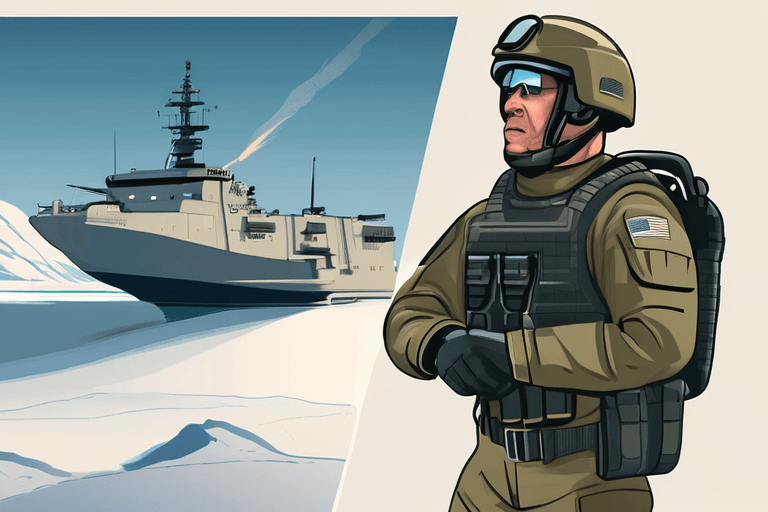
A small French military contingent arrived in Nuuk, Greenland's capital, officials said, marking the start of a limited deployment by several European nations. The deployment, which includes personnel from Germany, Sweden, Norway, Finland, the Netherlands, and the UK, is described as a reconnaissance mission.
The European deployment coincides with ongoing assertions by U.S. President Donald Trump regarding the United States' interest in acquiring Greenland, a semi-autonomous territory of Denmark. French President Emmanuel Macron indicated the initial contingent would soon be augmented with "land, air, and sea assets." Olivier Poivre d'Arvor, a senior French diplomat, characterized the mission as a significant political statement, stating, "This is a first exercise... we'll show the US that Nato is present." The initial French deployment consisted of 15 personnel.
The arrival of European military personnel occurred hours after Denmark and Greenland's foreign ministers met with U.S. Vice-President JD Vance in Washington on Wednesday. Danish Foreign Minister Lars Løkke Rasmussen described the talks as constructive, while also acknowledging that differences remain.
The European deployment to Greenland highlights the increasing geopolitical importance of the Arctic region. As climate change causes ice to melt, new shipping routes and access to natural resources are becoming available, attracting the attention of various nations. The presence of European military personnel can be interpreted as a signal of Europe's commitment to maintaining stability and asserting its interests in the Arctic.
The situation underscores the complex interplay of national interests, security concerns, and resource competition in the Arctic. The U.S. interest in Greenland, coupled with the European military presence, suggests a potential for increased strategic rivalry in the region. The next steps will likely involve further diplomatic discussions between Denmark, Greenland, the United States, and European nations to address the evolving situation and ensure a peaceful and cooperative approach to Arctic governance.














Discussion
Join the conversation
Be the first to comment